1. Mythological Origins of the Yoruba People
Yoruba mythology teaches that Oduduwa—revered as the founding father of the Yoruba race—descended from the heavens on a sacred chain to establish Ile-Ife.
Ile-Ife is still seen today as the spiritual cradle of Yoruba civilization, and this myth strengthens the people’s deep cultural identity and communal pride.
Key Points:
- Oduduwa: divine progenitor of the Yoruba.
- Ile-Ife: birthplace of Yoruba civilization.
- Cultural Identity: myth reinforces unity and heritage.
2. Highest Twin Birth Rate in the World
The Yoruba rank as the world’s most twin-bearing ethnic group, with a twin-birth rate of about 4.4%, as reported by Cambridge University.
This phenomenon is linked to local diets, especially yam consumption. Twins are celebrated, honored with rituals, and seen as symbols of blessing and prosperity.
3. Yoruba Language and Dialects
Spoken by over 50 million people, Yoruba belongs to the Niger-Congo language family and has several mutually intelligible dialects like Ekiti, Ijesha, and Egba.
The language is rich in proverbs, idioms, and oral traditions that help preserve culture and philosophy.
Highlights:
- Diverse dialects with strong mutual understanding.
- Proverbs central to communication and cultural teachings.
- Widely spoken across Africa and the diaspora.
4. Historical Yoruba Homeland
The Yoruba homeland spans southwestern Nigeria and extends into Benin and Togo, housing over 60 million people.
Cities like Lagos and Ibadan serve as major political, cultural, and economic hubs in West Africa.
5. Traditional Yoruba Religion
Around 20% of Yoruba people still practice their indigenous religion, which is centered on the worship of Orishas.
Olorun is regarded as the supreme deity, while gods like Ogun and Eshu play vital roles in daily life. These beliefs blend seamlessly with Christianity and Islam in many communities.
Notes:
- Polytheistic worship of Orishas.
- Strong tradition of religious syncretism.
- Influential in the development of Voodoo and Hoodoo.
6. Vibrant Yoruba Festivals and Celebrations
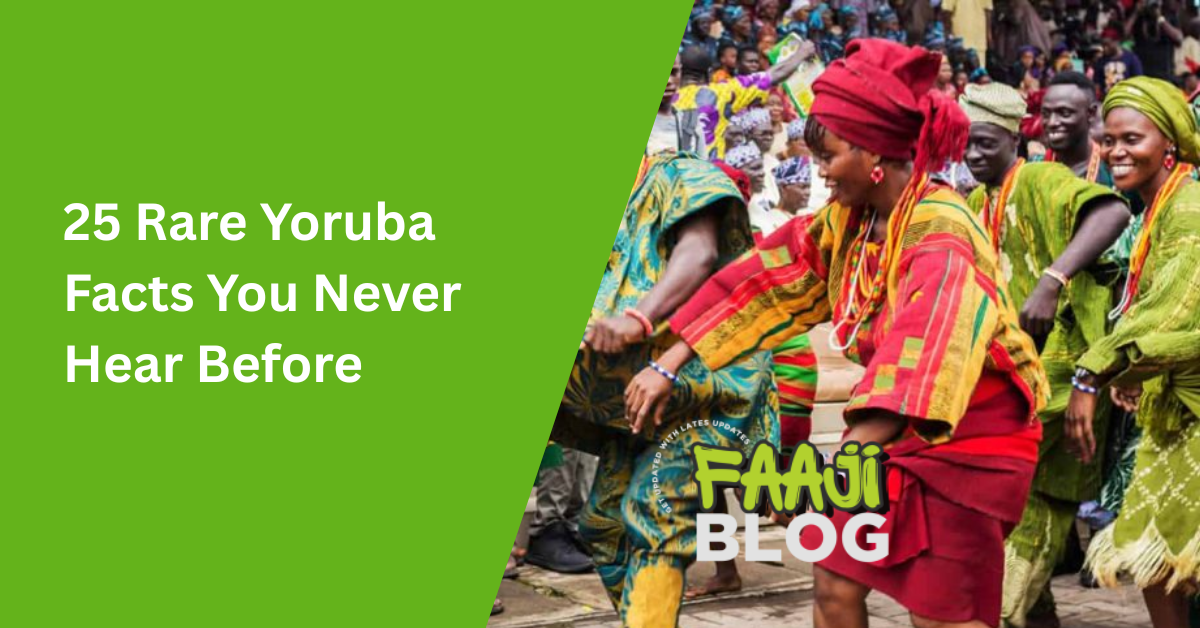
Yoruba festivals are colorful, rich, and deeply spiritual.
The famous Eyo Festival in Lagos stands out as a cultural spectacle honoring ancestors and marking transitions of life.
Traditional attire, music, drumming, and dance are essential elements of every major celebration.
7. Influence of Yoruba Folktales
Yoruba folktales, featuring characters like the mischievous Tortoise, are powerful tools for teaching morals, respect, and social values.
These stories are passed down orally, preserving history and wisdom for younger generations.
8. Highly Urbanized People
The Yoruba are among the most urbanized ethnic groups in Africa.
Lagos, Ibadan, and Abeokuta are major centers of commerce and culture.
Despite modern living, many communities still uphold age-old customs and practices.
9. Symbolism of Yoruba Names
Names hold great spiritual and cultural importance.
They reflect birth circumstances, destiny, or family aspirations.
Examples include:
- Taiwo – first twin to “taste the world.”
- Kehinde – the second twin.
Names are believed to influence one’s path in life.
10. Prominent Yoruba Historical Figures
The Yoruba have produced exceptional leaders and innovators, including:
- Nathaniel Thomas King – Nigeria’s first medical doctor.
- Wole Soyinka – first African Nobel Laureate in Literature.
Their achievements have shaped Nigeria and global culture.
11. Yoruba Role in Nigerian History
Yoruba leaders shaped early political structures in Nigeria.
The first political party, NNDP, was founded by Herbert Macaulay in 1923.
Yoruba people were also major contributors to the independence movement and remain influential in Nigerian politics.
12. Yoruba Cuisine
Yoruba food is flavorful, spicy, and culturally significant.
Popular meals include moin-moin, amala, and jollof rice.
Meals are often communal, symbolizing unity and togetherness.
13. Farming Traditions
Historically, over 75% of Yoruba men engaged in agriculture.
Staple crops include yam, cassava, maize, and cocoa.
Farming is tied to festivals, seasons, and religious beliefs, making it both a cultural and economic activity.
14. Africa’s First TV Station (WNTV)
In 1959, the Yoruba made history by launching Western Nigeria Television (WNTV), Africa’s first TV station.
This landmark achievement expanded cultural awareness through plays, news, and educational programs.
15. Nigeria’s First University
The University of Ibadan, founded in 1948, is Nigeria’s oldest university and one of Africa’s most respected institutions.
Its alumni include global leaders in politics, literature, science, and education.
16. Early Yoruba Professionals
The Yoruba produced Nigeria’s first lawyers and many early medical professionals.
Notable figures include:
- Chief Sapara Williams – first Nigerian lawyer (1879).
- Stella Thomas – first Nigerian female lawyer.
These pioneers shaped Nigeria’s legal and professional sectors.
17. Yoruba Art and Theater
Yoruba woodcarving, bronze works, and sculpture reflect deep spirituality.
Chief Hubert Ogunde, regarded as the father of Nigerian theatre, revolutionized stage performance with productions blending music, drama, and dance.
18. Yoruba Philosophy of Life and Death
The Yoruba view life and death as interconnected.
They believe in reincarnation and ancestral guidance, shaping practices around funerals, spirituality, and daily living.
19. Industrial Powerhouse of Nigeria
Lagos, located in Yoruba land, hosts over 70% of Nigeria’s industries.
It is the nation’s economic nerve center and one of Africa’s fastest-growing cities, powering growth in manufacturing, finance, and oil.
20. Yoruba Contributions to Literature and Music
Yoruba pioneers shaped Nigerian music and global literature:
- Canon J.J. Ransome-Kuti – produced Nigeria’s first music album in 1878.
- Wole Soyinka and Amos Tutuola – globally recognized writers.
Yoruba rhythms heavily influence Afrobeat and world music.
21. First Female Driver in Nigeria
Funmilayo Ransome-Kuti was the first Nigerian woman to drive a car.
She was also a major women’s rights activist, shaping equality and political participation in Nigeria.
22. Yoruba Twin Sculptures (Ere Ibeji)
Twins are spiritually important, inspiring the creation of ere ibeji, wooden sculptures carved to honor deceased twins.
These figures are believed to provide protection and maintain the spiritual presence of the twins.
23. Yoruba Influence Across Africa and the Americas
Through the transatlantic slave trade, Yoruba culture spread to countries like Brazil, Cuba, and Haiti.
Religions such as Santería and Candomblé retain strong Yoruba roots.
Their music, spirituality, and traditions continue to influence global culture.
24. Prominent Role of Yoruba Women
Yoruba women have historically held leadership roles—both at home and in public life.
Figures like Funmilayo Ransome-Kuti championed women’s rights, while others excel in medicine, law, politics, and education.
25. Rich Prehistoric Yoruba History
Archaeological findings from Ile-Ife reveal advanced ancient civilizations with sophisticated art, trade systems, and religious structures.
The Yoruba have lived in the region for thousands of years, contributing to Nigeria’s earliest history.
The Bottom Line
From ancient civilizations to modern global influence, the Yoruba tribe continues to play a defining role in Nigeria, Africa, and the world.
Their culture, language, religion, festivals, arts, and innovation form one of the richest cultural legacies in human history.