Flood Overruns Lagos Communities, Motorists and Businesses Count Heavy Losses
Vehicular and business activities were brought to a standstill across parts of Lagos State on Wednesday after hours of torrential rainfall triggered flash floods in several communities.
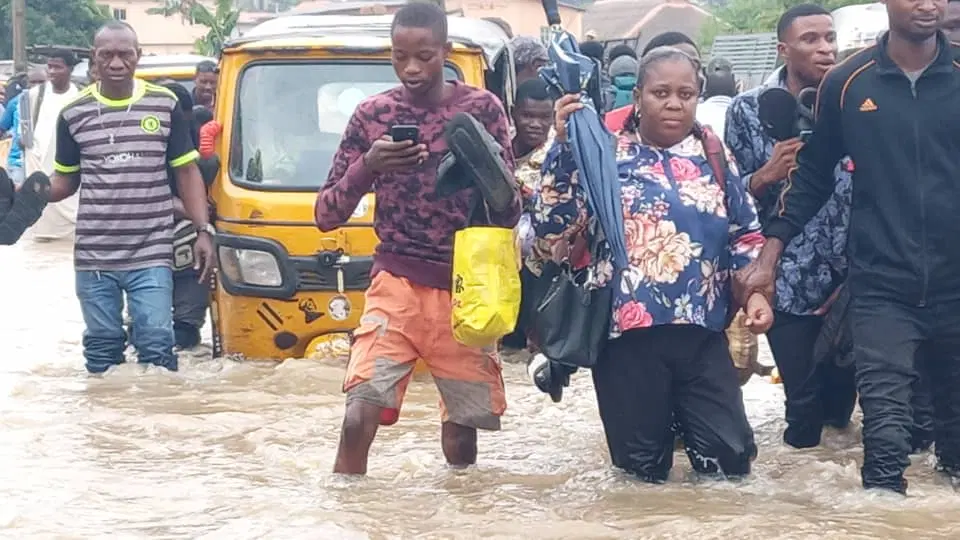
Areas such as Maryland, Lekki, Ogba, and Ikorodu were among the worst hit, with roads submerged, homes invaded, and businesses disrupted. Videos circulating on social media showed residents wading through flooded streets while motorists crawled through waterlogged roads, with some vehicles breaking down completely.
Residents and Business Owners Lament Flooding
At Olatunji Street in Maryland, the overflow of a canal cut off access to the Mende community.
Chinasa Nnadi, a resident, said flooding had become a recurring nightmare.
“This has been happening for years. People even swim to their houses. Some relocate because it’s unbearable,” she lamented.
Business owners were not spared. Kalu, who has lived in the area for three years, described how water swept into his shop. Similarly, Christiana, a church member, explained that their worship centre was flooded, damaging costly musical instruments.
Commuters Trapped in Gridlock
Motorists and commuters also faced hours of gridlock, especially at the notorious Ogba-Wempco junction.
A commuter, Tunji Abass, shared how traffic worsened as vehicles broke down in the flood.
“It has always been like this in the rainy season. Sometimes water flows into people’s cars. Government needs to fix this urgently,” he said.
Another resident, Victor Obinna, confessed that he often sleeps in his office during heavy rains to avoid getting stuck in traffic, adding that walking through floodwaters had become routine.
Economic and Health Risks
The recurring floods in Lagos cost residents billions of naira annually, destroying homes, shops, vehicles, and valuable man-hours. Experts also warn of health risks, as stagnant water can trigger outbreaks of waterborne diseases.
Government’s Response
The Lagos State Government sympathised with affected residents and assured that efforts were ongoing to address the crisis.
According to the Commissioner for the Environment and Water Resources, Tokunbo Wahab, Lagos remains highly vulnerable to flooding due to its coastal nature. He revealed that flooding in parts of Lekki was linked to drainage challenges and illegal construction on floodplains.
Wahab stressed that the government was investing in drainage infrastructure, desilting canals, and enforcing environmental laws. He also vowed that illegal structures and obstructions worsening the situation would be removed.
“Together, we can build a safer, cleaner, and more resilient Lagos,” Wahab assured, urging residents to stop dumping refuse in drains and avoid building on waterways.